
Washington Court House Court Docket Searches
Two docket systems serve Washington Court House, and they do not share records. For Municipal Court traffic, criminal, civil, small-claims, and parking cases, use the Municipal CaseLook Record Search. For the trial court, turn to Common Pleas CaseLook. It offers CA, CV, CR, DR, JL, and MI filters. Pick the system that matches the court on your citation or notice. Do not rely on the city name alone. Each tool takes different inputs. Municipal CaseLook lets you search by party or company name, birthdate, numeric case number, file date, license number, ticket number, hearing date, violation date, and type. The Common Pleas form has name, hearing-date, numeric-number, and type fields. It asks for one criterion at a time. A result can point you to a record. But the court's current notice or a clerk-provided copy still controls.
- Read the notice and identify whether it names Washington Court House Municipal Court or a Fayette County court division.
- Use the matching CaseLook system and its local name or numbers-only field format.
- Select a type filter only after choosing the correct court and case category.
- Use a calendar tool to locate a listed public setting, then read dated docket entries in sequence.
- Contact the correct clerk for verification, a particular public document, or a certified copy.
Note: Searching one CaseLook system never reaches the other court's docket. Run a Washington Court House court docket search in both if you are unsure which court holds the case.
Washington Court House CaseLook Search Fields
CaseLook sorts results by the type and search field you choose. Traffic cases carry TRC or TRD. Municipal criminal uses CRA or CRB. Civil splits across CVE, CVF, CVG, CVH, or CVT, with CVI for small claims and PRK for parking. These codes are interface groupings, not full case descriptions. If a narrow Municipal search comes back empty, the court's own interface advises loosening your criteria.
| Field | Use | Local format or note |
|---|---|---|
| Party / Company Name | Find a municipal court record by party | The form shows “Last, First.” |
| Case or ticket number | Locate an identified docket | Numbers only; each field allows up to 16 characters. |
| File, hearing, or violation date | Limit a search by the relevant event | These dates answer different questions and should not be treated as interchangeable. |
| Type filter | Route traffic, criminal, civil, small claims, or parking | Use it to narrow the Municipal system, not to establish an outcome. |
The Washington Court House Municipal Court site covers the record search, calendar, forms, fees, and payments for this court's docket.
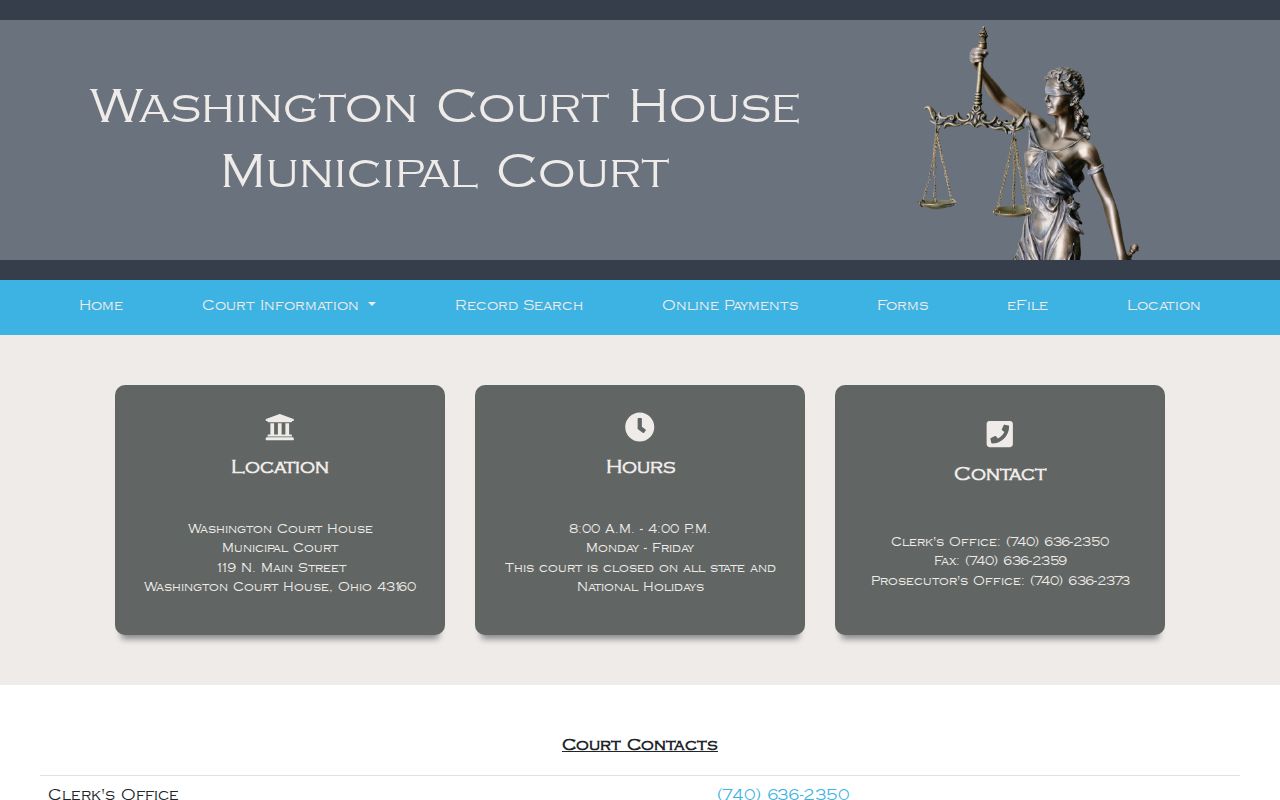
The Municipal Court site ties together its record-search, calendar, form, fee, and payment channels. Each of those channels sits apart from the CaseLook tool that serves Common Pleas.
Washington Court House Municipal Court Basics
Washington Court House Municipal Court sits at 119 North Main Street, Washington Court House, Ohio 43160. The City lists the office phone at 740-636-2350. It is staffed Monday through Friday from 8:00 a.m. to 4:00 p.m. Public access runs through the court's own clerk, the Municipal CaseLook Record Search, a month calendar, and a schedule view. When a Washington Court House court docket involves traffic, a municipal criminal matter, municipal civil, small claims, or parking, this is the practical local starting point.
Its home address does not make the docket city-only. The City describes municipal jurisdiction as covering Washington Court House plus named Fayette municipalities and parts of municipalities. That countywide reach matters. It explains why a traffic or misdemeanor case from Jeffersonville or Bloomingburg can still land in this court's system. Court choice still follows the charge, court name, and case type.
The City's Municipal Court page posts the court's contact details. It also gives the full description of municipal jurisdiction for the Washington Court House court docket.
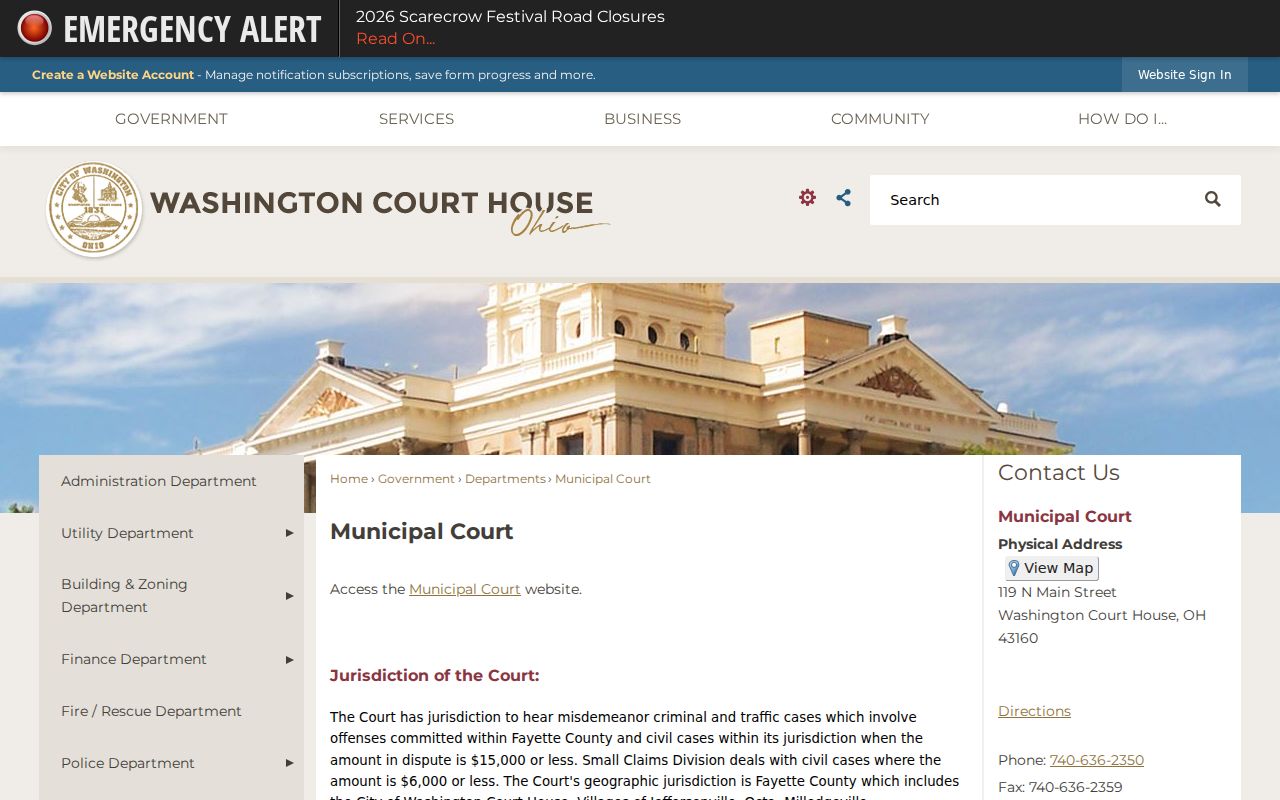
The City page names the court and lays out its local access details. Its jurisdiction explanation also warns against letting a city-address guess narrow a docket search too far.
Washington Court House Court Docket Jurisdiction
A Washington Court House court docket may sit in Municipal Court or in Fayette County Common Pleas. It depends on the court level. Municipal Court handles traffic, misdemeanor criminal matters, parking, municipal civil, and small claims. Common Pleas General takes felony criminal, general civil, and appeals. It also covers the CA, CV, CR, and MI groupings. Domestic Relations, Probate, and Juvenile divisions run their own routes. Each may set distinct public-access limits.
| Washington Court House matter | Docket starting point | Key distinction |
|---|---|---|
| Traffic or municipal criminal | Municipal CaseLook | Use TRC/TRD or CRA/CRB as the local interface route. |
| Municipal civil or small claims | Municipal CaseLook | Civil and CVI are separate filters. |
| Common Pleas criminal or civil | Common Pleas CaseLook | The Common Pleas system has separate types and search instructions. |
| Probate or Juvenile | Division-level office | Do not infer that a General CaseLook no-result covers those records. |
Fayette County Common Pleas sits at the courthouse complex at 110 East Court Street. The Fayette County Clerk of Courts is the records contact for Common Pleas. The separate docket systems are a routing fact. They are not a reason to merge records that different offices hold. Each clerk keeps its own files.
Court Dates and Settings in Washington Court House
The Municipal Court posts both a month calendar and a schedule view. The month view filters by month, year, and attorney. The schedule view works off date range, attorney, and official controls, with generic columns for time, case, party, description, status, and a representation indicator. A listed setting on a Washington Court House court docket helps with orientation. It does not supersede a notice from the court.
| Date | The day a Washington Court House setting is displayed or stated in the court notice. |
|---|---|
| Time | The listed time of the event; confirm it with the calendar or clerk if a live appearance is involved. |
| Case | The court identifier shown in the schedule, which should be matched to the notice. |
| Description | A setting label such as arraignment, pretrial, status hearing, or court trial. |
| Status | A calendar label that must be read with the date and docket; it is not a judgment. |
A hearing date is not a file date, and neither is a violation date. The Municipal search form keeps those inputs separate. Common Pleas Calendar Search instead uses a beginning date, optional ending date, type, result size, and CAPTCHA. It splits those fields apart. Neither calendar is a full transcript of every court action.
Washington Court House Court Docket Verification
Not every posted schedule settles the question. The City's general Municipal Court page lists Wednesday arraignments at 9:30 a.m. The January 2026 Municipal Court rules tell a different story. They set non-incarcerated Wednesday arraignments at 9:00 and 11:00 a.m. Jail arraignments fall on weekdays at 10:00 a.m. Neither schedule is a fixed answer for a particular case. Confirm the live setting through the Municipal calendar or the clerk.
Continuances need the same care. A request is not a granted date. Municipal Court publishes a continuance form. Common Pleas local rules describe motion and continuance practices. A Washington Court House court docket can show a request, a status conference, or a court-trial setting. It does not prove the change or the final result ever happened.
Verify before appearing: A public schedule is a starting point only. The court notice and the clerk control if a Washington Court House setting differs from a general calendar listing.
Traffic Tickets in Washington Court House
Read the citation before searching anything. It names the charging court. It also carries the case or citation number, appearance direction, and stated deadline. Municipal CaseLook offers several search paths for a Municipal Court matter. Search by ticket number, license number, party or company, hearing date, violation date, file date, or numeric case number. Traffic matters carry the TRC and TRD filters. For a live Washington Court House court docket setting, the calendar or clerk comes next.
Waivable tickets can be paid by mail or in person. Card payments run through the court-linked nCourt channel. A phone service also accepts them. The published traffic schedule gives fine amounts only for violations that do not require an appearance. So a searchable citation is not automatically waiverable. Check the court named on the citation first. For countywide traffic record detail, turn to the separate Fayette County traffic tickets resource.
Washington Court House Docket Payment Channels
Payment, docket search, and a record-copy request are three distinct Washington Court House court tasks. The court-linked nCourt channel takes eligible municipal payments. The Clerk's legal-division payment channel is a separate system. Treat it as neither a Municipal Court payment option nor a docket lookup, since a payment screen never establishes what a court docket shows about a live case.
The Clerk payment channel is the official payment page that follows, covering legal-division payments for the Washington Court House court docket. Use it for legal-division payments only.
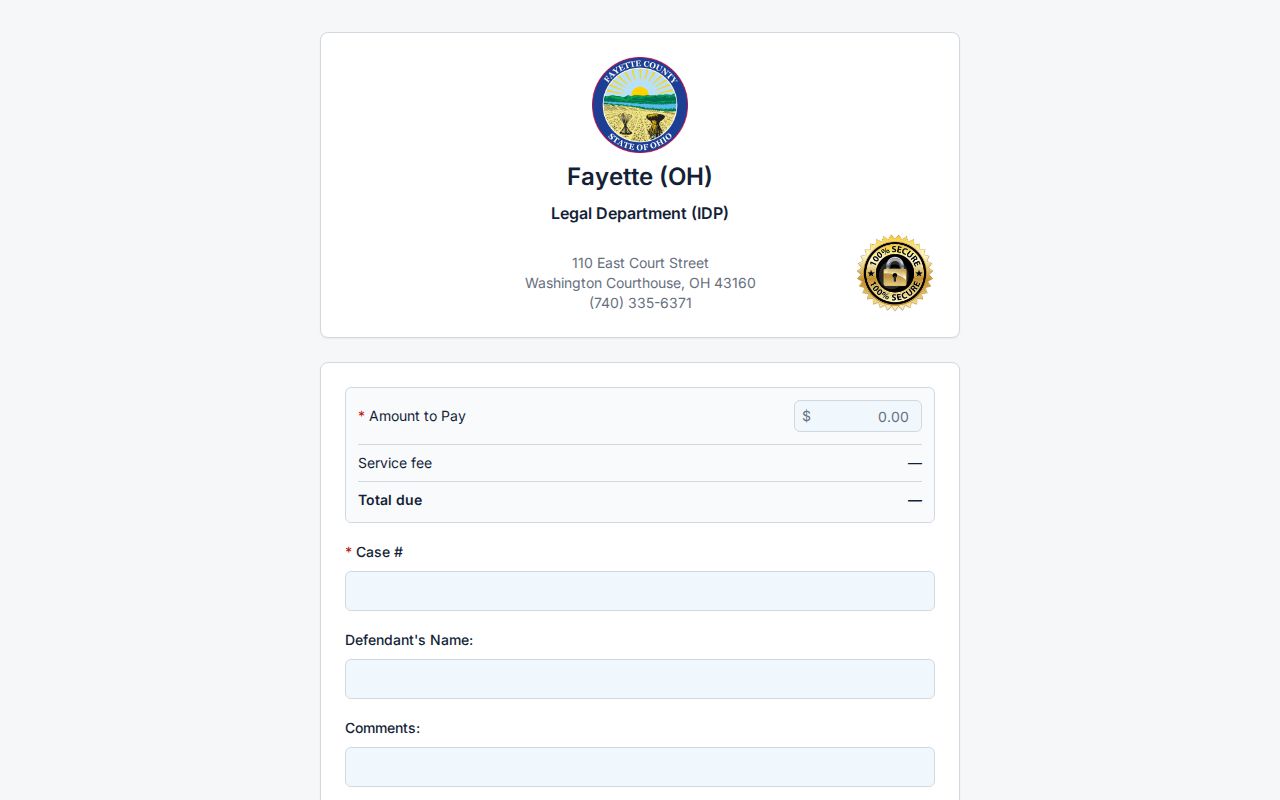
Two channels, two courts. Use Municipal Court for its cases, payments, calendar, and clerk questions, and send Common Pleas matters to that court's own record and payment process.
Where Washington Court House Cases Go
Not every Washington Court House case stays in Municipal Court. A felony travels the Fayette County route identified for that case. So does a larger civil matter. The same goes for a Common Pleas criminal or civil case, an appeal, or a domestic-relations matter. Municipal Court keeps its own docket for local matters. It can also handle initial criminal proceedings that precede a later Common Pleas felony record. Two court dockets, with different numbers and dates, can result from one search.
Docket flow: Washington Court House Municipal Court → Fayette County Courts → Fayette County Court of Common Pleas
Common Pleas matters run through Common Pleas CaseLook and the Clerk of Courts. Appeals go to the Twelfth District Court of Appeals. That court maintains its own appellate record once a qualifying appeal is lodged. Court level decides the next docket system. The Washington Court House address does not.
Washington Court House Docket Filing Context
Washington Court House Municipal Court is Fayette's only limited-jurisdiction trial court. The Ohio Supreme Court historical trial-courts report says so. That report lists one full-time judgeship. Its final column, labeled 2024, reports 6,519 total filings. Of those, 4,515 were traffic filings. The report carries a year-label inconsistency, so read the figures exactly as labeled. They are not a newer verified annual total. They are not a city-only case count either.
Ohio eStats Public is the official interactive source for current structured court statistics.
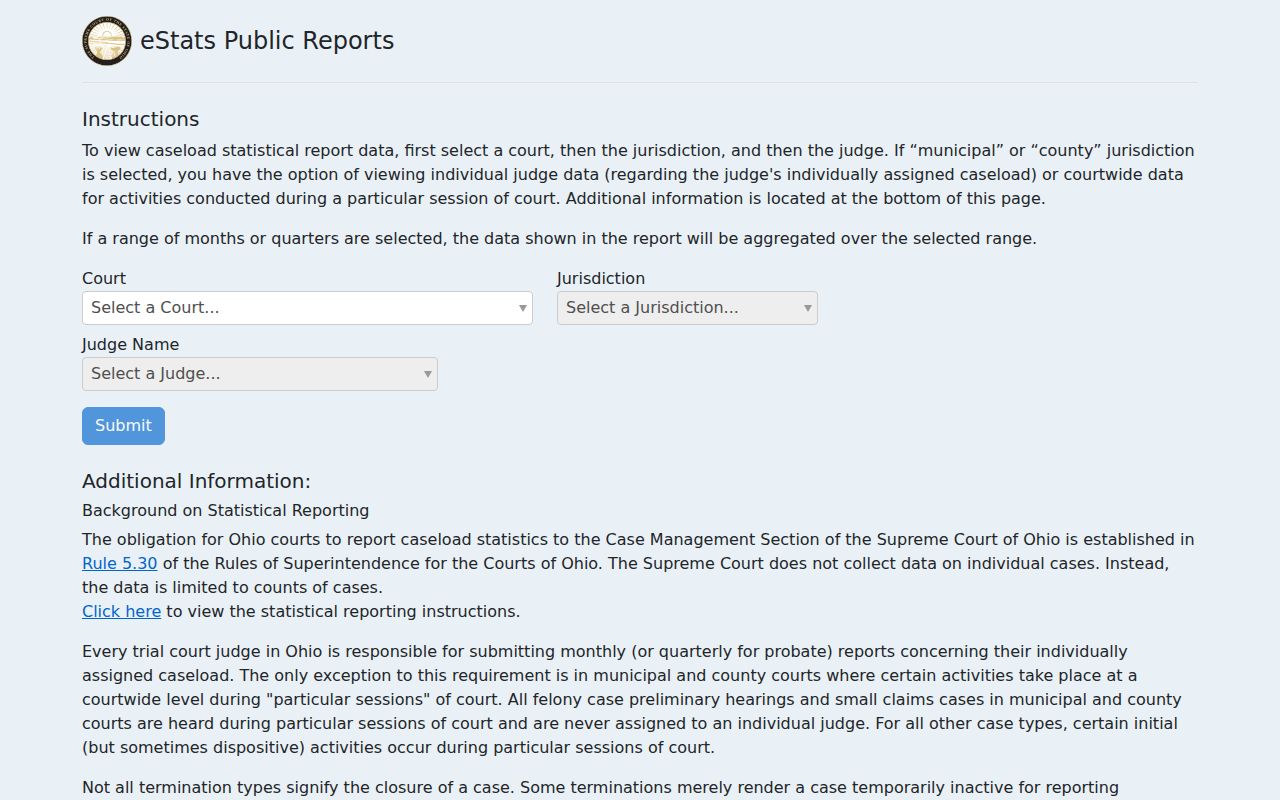
eStats needs three picks: court, reporting period, and report. A current figure should retain those selections. The Ohio court statistical reporting information page lays out how the state structures its court data, along with any source export that accompanies a figure.
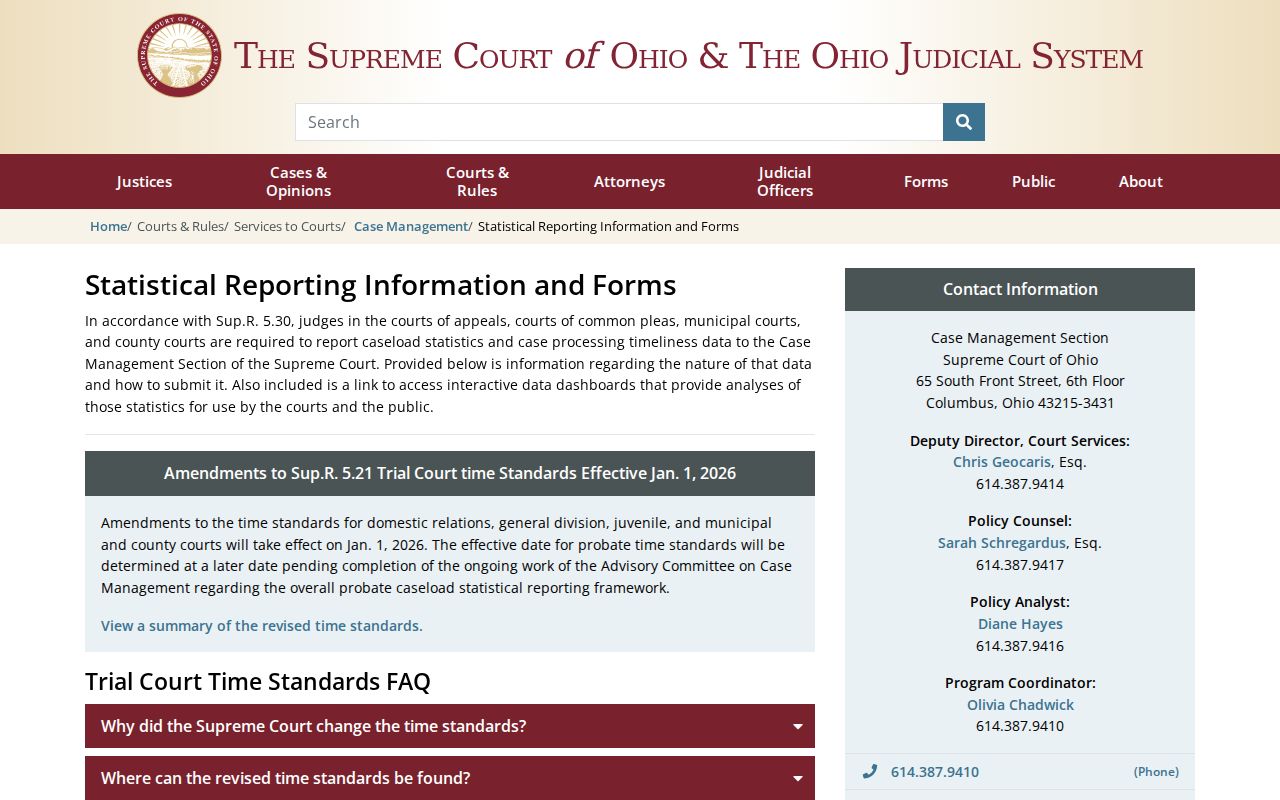
That reporting setup explains a habit worth keeping. Any later Washington Court House docket statistic should name its selected court, period, and definition.
Washington Court House Court Record Access Rules
Ohio's Rules of Superintendence govern Washington Court House court records. Rules 44 through 47 do most of the work. Rule 45 starts from a presumption of public access but permits exceptions, restriction procedures, and protection for personal identifiers. Municipal rules make the clerk's dockets, records, and indices public records, though certain reports are excluded from ordinary copying or viewing. And no criminal or civil complaint is released before service.
For a Municipal Court copy, gather the case number, the public docket or document sought, and whether a certified copy is needed. The Municipal fee page, effective December 4, 2024, sets the rates. Photocopies cost $0.15 per page. A certified document runs $10. Audio is $20. Common Pleas fees are different. Request them from the Fayette County Clerk of Courts. A portal printout is not automatically a certified court record.
Access rules: Ohio Sup.R. 44-47 provides the court-record access framework. R.C. 2303.12 addresses Common Pleas general-docket duties and qualifying electronic access. R.C. 2303.901 requires parties to omit personal identifiers from case documents.
Washington Court House Historic Docket Route
Digging for an older Washington Court House court docket takes a different path. A live CaseLook search will not reach it. Fayette County sends pre-2001 Common Pleas research through a Kofile/AppXtender channel. The Records & Archives Center sits at 201 South Fayette Street. Ask it which record series covers your case and how to reach it. One caution applies here. An empty search result on a modern portal does not mean the old court record never existed.
Local rules for the Municipal Court set retention at 50 years for civil, traffic, and criminal files. Storage rules still apply. That policy is not a promise that every historic document is online. When you contact the right custodian, be ready. Bring the court, any known identifier, the date range, and the item you want.